NuclearSAFE trademark logo NuclearSAFE Technology Platform Company
SuperLAT® industrial foundation

The drilling technology already works.

SuperLAT does not ask the nuclear industry to invent deep horizontal drilling, remote pipe handling, pressure control, well logging, intervention, re-entry or permanent well closure. The global oil and gas industry performs these tasks every day—at depth, at pressure, onshore and offshore, with engineered redundancies and mature operating standards.

No new drilling physics. NuclearSAFE's work is to adapt, integrate and qualify this mature industrial capability for the very different requirements of nuclear service.
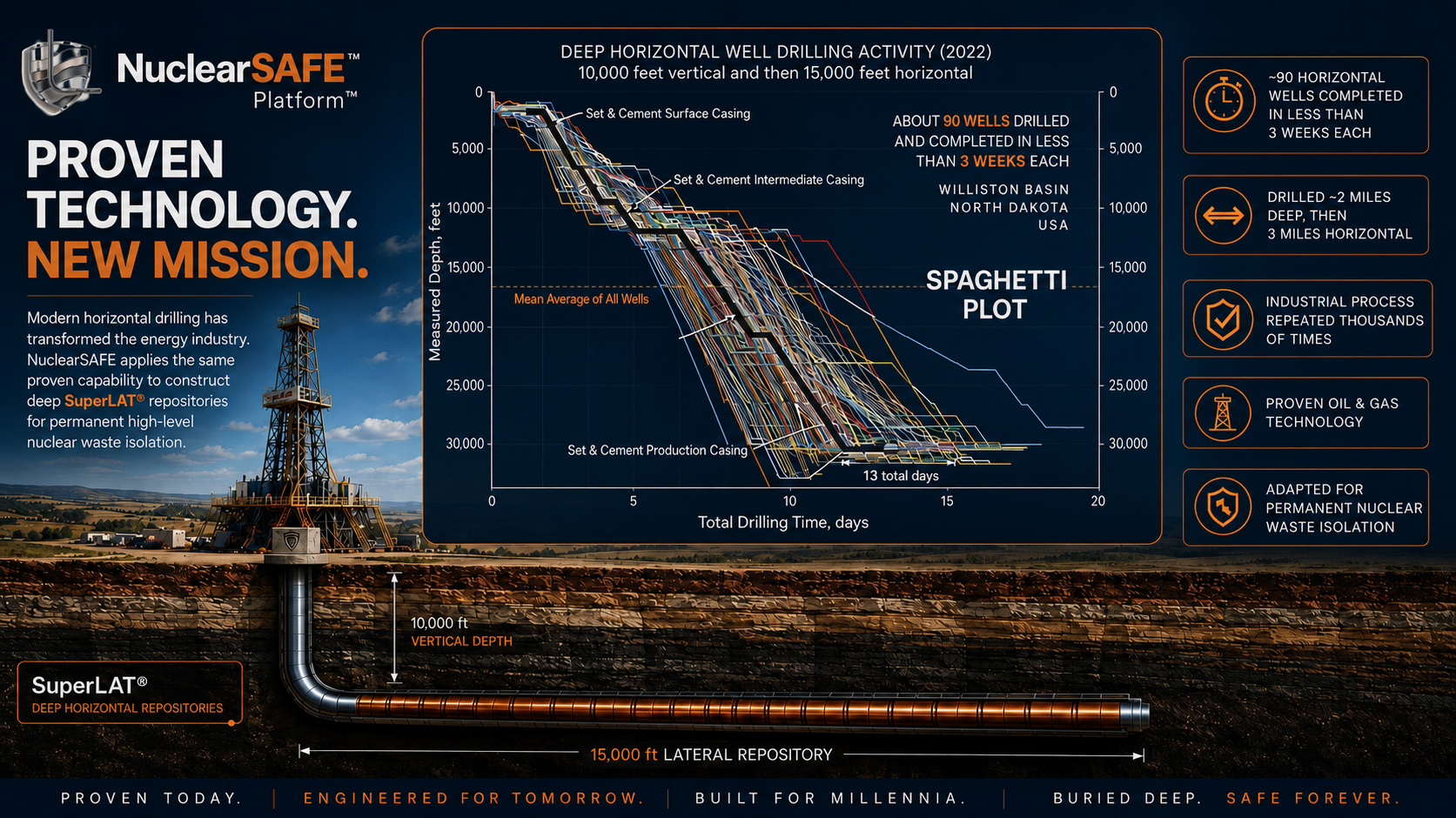
NuclearSAFE graphic showing deep horizontal drilling activity and SuperLAT geometry
Industrial drilling precedent: deep vertical sections, long laterals, remote control, casing, logging and repeatable well construction.
11,700 U.S. horizontal wells Approximately this many Lower-48 horizontal wells came online in 2024.
94% / 92% Oil / gas output Horizontal wells supplied 94% of Lower-48 oil and 92% of gas in Dec. 2024.
1,783 Worldwide active rigs Baker Hughes worldwide rig count, December 2025.
50,000 ft Extended-reach record ADNOC Upper Zakum well drilled from an artificial island.
What a modern drilling system actually is

Not a hole in the ground. A controlled industrial system.

For a technocrat unfamiliar with drilling, the scale of the supporting technology is easy to underestimate. A modern well is constructed by an integrated surface-and-downhole system combining robotics, high-pressure equipment, real-time sensing, directional control, redundant barriers, remote operations and established contingency procedures.

01

Automated rig floor

Top drives, pipe rackers, power catwalks and iron roughnecks make and break tubular connections, move pipe and reduce personnel exposure in hazardous zones. NOV describes fully automated drill floors and hands-free casing handling as standard commercial offerings.

02

Steering while drilling

Rotary-steerable systems, MWD and LWD continuously guide the well path and transmit downhole measurements to surface. Long curves and laterals can be drilled in a single bottomhole-assembly run.

03

Pressure control

BOPs, choke-and-kill systems, managed-pressure drilling, wellheads and trees are engineered around containment and control. Commercial wellheads are routinely rated to 15,000 psi; specialized HPHT systems reach 30,000 psi.

04

Data and remote control

Real-time monitoring, remote operations centers and automated drilling sequences allow experts away from the wellsite to supervise, diagnose and optimize operations on a common data stream.

05

Completion and stimulation

Frac trees, high-pressure pumps, wireline and perforating systems operate under demanding pressure cycles. Halliburton now offers fully autonomous fracturing with thousands of sensors and automated tasks per stage.

06

Downhole fail-safes

Packers, bridge plugs, subsurface safety valves and flow-control devices provide independent barriers and shut-in capability. Subsurface valves are specifically designed to prevent uncontrolled flow if surface controls are damaged.

07

Intervention and re-entry

Coiled tubing, wireline, snubbing, fishing, milling, casing repair and sidetracking allow operators to return to old or damaged wells, retrieve stuck equipment and restore access under pressure.

08

Temporary and permanent closure

Cement barriers, mechanical plugs, casing cuts, section milling and verified P&A systems isolate formations and permanently close wells. Re-entry and re-abandonment are mature specialties—not exceptional improvisations.

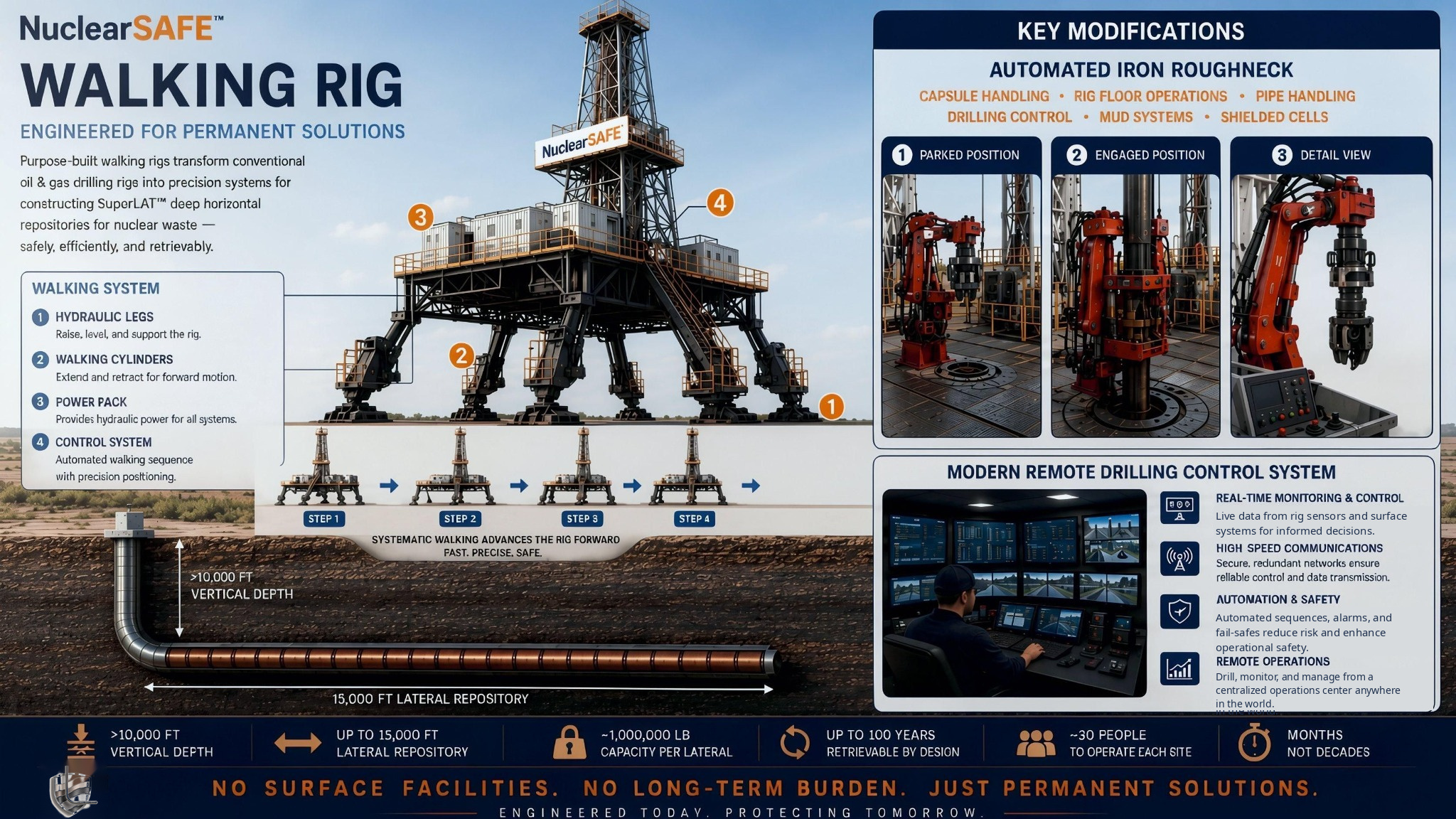
NuclearSAFE walking rig and automated drill-floor concept
NuclearSAFE concept: walking rig, automated iron roughneck, remote drilling control and deep horizontal repository geometry.
Surface equipment today

Automation has already moved people away from the red zone.

The modern rig floor is increasingly mechanized and digitally controlled. NOV's commercial systems include automated pipe handling, top drives, iron roughnecks and reflexive drilling control. Nabors rigs can walk between well centers with the setback loaded, while ancillary equipment moves with the rig.

Why this matters to SuperLAT: NuclearSAFE does not need to invent a new industrial handling culture. It needs to adapt proven remote handling, interlocks, controls and operating discipline to shielded capsule handling and nuclear-quality requirements.
Selected real-world proof

Long, difficult wells are already routine engineering—not science fiction.

The examples below are deliberately drawn from different geographies and operating environments. Public sources do not consistently disclose individual well budgets, so NuclearSAFE should not invent “on-budget” claims. Where cost or schedule performance is public, it is shown.

Region / operator Published performance Operational point Relevance to SuperLAT
Upper Zakum, UAE — ADNOC 50,000 ft measured well length, world record announced in 2022. Extended-reach well drilled from an artificial island to access reservoir without additional surface infrastructure. Demonstrates reach substantially beyond a 10,000-ft vertical + 15,000-ft lateral SuperLAT concept.
Odoptu, Sakhalin-1 — Exxon-led consortium 40,502 ft MD; 11,475 m horizontal reach; completed in 60 days. Shore-based rig drilled miles offshore. Exxon reported the development meeting cost and schedule expectations. Long-reach well construction has decades of field pedigree under severe logistics and geology.
Marcellus Basin, USA — Baker Hughes / operator Drilled from 5,618 ft to 25,920 ft TD in under 8 days; 95.5% in zone. Directional drilling and MWD engineers operated remotely; saved at least 12 hours in trip time. Shows remote supervision, placement accuracy and rapid execution in a complex ERD well.
Northeast USA — Baker Hughes 20,463-ft curve-and-lateral single run; 6,194 ft drilled in one 24-hour period; zero HSE incidents reported. Remote operations managed the well using shared real-time data. Direct evidence that long curved and horizontal sections can be executed as controlled repeatable runs.
Williston Basin, North Dakota — Baker Hughes 10,294-ft lateral in 46.3 drilling hours; 40% better drilling time than offsets. Completed lateral in a single run; 35% higher ROP; 2 drilling days saved. Near-SuperLAT lateral scale achieved in days with commercial tools.
Permian Basin, USA — Baker Hughes 10,061-ft lateral in 53.75 hours; full lateral in one run. Record customer performance; reduced slide time and wellbore tortuosity. Shows repeatability and precision of long-lateral drilling in large-scale shale manufacturing.
Vaca Muerta, Argentina — YPF 2025 investor data show typical lateral lengths around 3,000 m; YPF previously reported 3,200–3,800 m laterals. Factory-style unconventional development using multiwell pads and repeated hydraulic fracturing. Confirms that long horizontal development is a global operating model, not a U.S.-only capability.
China — CNPC CNPC reported a 3,190 m deep-shale-gas horizontal rotary-steerable one-run record in Sichuan and automated ultra-deep drilling systems. Real-time data and remote engineering support are part of current deep-well programs. Demonstrates global transferability of advanced directional drilling and automation.
The critical question

What happens when something goes wrong?

Oilfield engineering is credible not because failures never occur, but because the industry has developed layers of detection, containment, recovery and alternate-path procedures. Macondo showed the consequences when barriers and decision systems fail—and it drove stronger standards, testing, real-time monitoring and subsea containment requirements.

NuclearSAFE's position: mature contingency practice is an asset. The design basis should assume equipment can fail and provide independent paths to stop, recover, isolate, retrieve, sidetrack or abandon safely.
1

Kick or unexpected pressure

Detect influx, shut in the well, use BOP/choke systems, circulate and restore pressure control.

2

Stuck or lost downhole equipment

Fish, jar, mill, wash over, cut or retrieve. Tools can be recovered at extreme depths; SLB reports a 27,440-ft deepwater radioactive-source fishing job with zero HSE incidents.

3

Damaged casing

Diagnose with logs, install internal patches, squeeze cement or sidetrack. A New Zealand casing breach was repaired and pressure-tested in 10 days before sidetracking.

4

Live high-pressure well

Snubbing and coiled-tubing systems permit controlled intervention with wellhead pressure present. Halliburton documents live-well fishing at about 3,600 psi.

5

Old or previously abandoned well

Re-enter, reconnect casing, mill plugs, clean, inspect, repair and re-abandon. SLB reports nine Gulf wells re-entered and re-abandoned in 145 days with no pressure-related or HSE incidents.

6

Unusable wellbore

Isolate and plug it, then sidetrack or drill another wellbore. The asset is modular; the entire program is not hostage to a single excavation.

Redundancy is structural

A well is repeatable infrastructure. A mine is a concentrated civil works project.

SuperLAT / wellbore model

  • Individual wellbores are discrete, repeatable units.
  • Modern pad rigs walk or skid between well centers with major equipment connected.
  • Nabors publishes 120-ft standard walking capability with 100-ft extensions for one rig family; other systems are configurable.
  • Pad-to-pad rig moves can be measured in days rather than years of excavation.
  • A problem wellbore can be plugged, sidetracked or replaced while the broader program continues.
  • Drilling execution benefits from accumulated learning across thousands of analogous wells.
VS.

Mined repository model

  • Large shafts, ramps, tunnels, ventilation, underground utilities and workforce infrastructure are interdependent.
  • Design changes propagate through a large civil construction program.
  • A geological or construction problem in a major excavation can create substantial sunk-cost exposure.
  • Redundancy generally requires more excavation, not another standardized bore.
  • Construction and operating footprints are inherently larger and less modular.
This comparison addresses the construction and operating architecture, not the ultimate safety case. Any nuclear repository—including SuperLAT—would still require site-specific characterization, performance assessment, licensing, nuclear QA and regulatory approval.
Oilfield interface → nuclear mission

NuclearSAFE knows what to specify, what to measure and what answers should look like.

The commercial oilfield supply chain can provide the mature machinery and operating disciplines. NuclearSAFE's role is to integrate those capabilities into a repository system with nuclear-specific requirements layered on top.

Oilfield capability
What the industry already does
NuclearSAFE adaptation
Directional drilling
Plan, steer and verify deep horizontal trajectories with RSS/MWD/LWD.
Construct repeatable SuperLAT geometry in qualified host formations.
Casing & cementing
Run, centralize, cement, pressure-test and document multi-string casing systems.
Apply nuclear QA, materials compatibility, long-term barrier and retrievability requirements.
Well control
BOPs, choke/kill, managed pressure, wellhead isolation, monitored barriers.
Define conservative operating envelopes and multiple independent stop/isolation states.
Automated pipe handling
Robotic catwalks, rackers, iron roughnecks, remote control and red-zone management.
Shielded capsule receipt, handling, transfer and emplacement with personnel separated from the payload.
Downhole sensing
Real-time position, pressure, temperature, vibration, formation and tool-status data.
Emplacement verification, thermal monitoring, integrity confirmation and digital repository records.
Intervention / re-entry
Coiled tubing, wireline, fishing, snubbing, milling, casing repair and sidetracking.
Planned retrieval and contingency access during the authorized stewardship period.
P&A / closure
Mechanical barriers, cement, section milling, verification and permanent abandonment.
Engineered repository closure, including NuclearSAFE-specific sealing technologies subject to qualification.
It is in our DNA

This is not a greenfield learning exercise for NuclearSAFE.

NuclearSAFE's leadership and technical network combine nuclear-waste development with decades of drilling, reservoir engineering, well control, geology, materials, automation, simulation and international field work.

Founder Dr. Henry Crichlow's career includes petroleum and geological engineering leadership, horizontal-well and gas-storage development, creation and direction of a USGS-certified oil-well blowout-control school at the University of Oklahoma, Kuwait oil-fire recovery planning, and technical expert work involving major well-control and drilling matters. NuclearSAFE's broader team adds nuclear operations, drilling, geology, materials, manufacturing, AI, environmental systems and project execution.

NuclearSAFE does not need to learn how the oilfield works. It knows the vocabulary, the equipment hierarchy, the contractor interfaces, the failure modes, the questions that must be asked—and what competent answers look like.
The SuperLAT proposition

Mature industrial capability. A new mission.

The distinguishing NuclearSAFE proposition is not that oilfield drilling and completion equipment is novel. It is that this enormous, highly evolved industrial capability can be deliberately repurposed for permanent nuclear-waste disposal—while adding the nuclear-specific controls, evidence and regulatory qualification the mission demands.

For the concerned technologist: the well-construction problem is not unprecedented. The novel work is systems integration for nuclear service. That is a far more manageable starting point than inventing an entirely new underground construction industry.
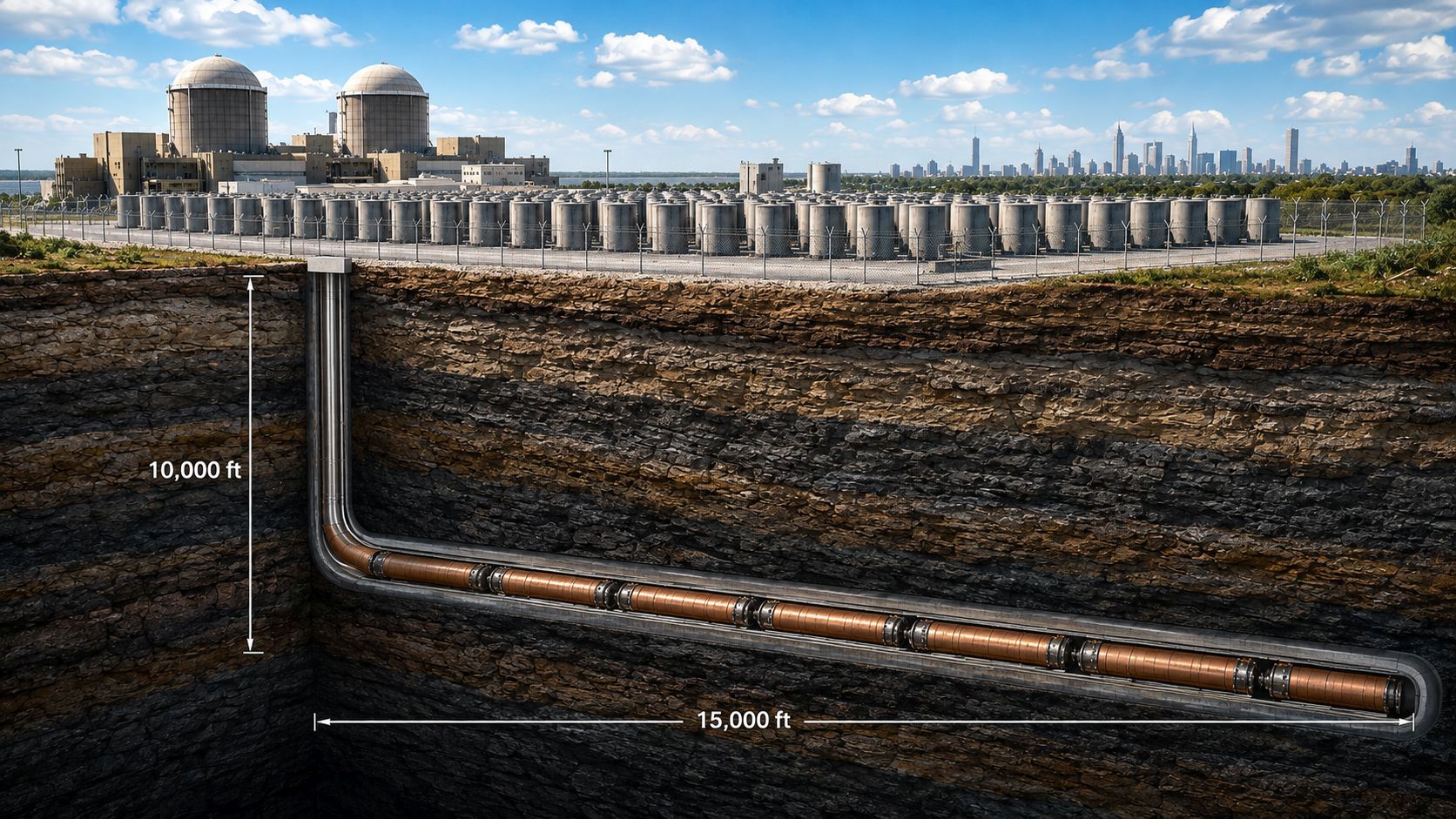
NuclearSAFE SuperLAT concept with nuclear plant, surface storage and deep horizontal repository
Conceptual engineering visualization — not an operating NuclearSAFE facility. Nuclear deployment remains subject to testing, qualification, site characterization, regulatory review and licensing.
Source trail

Evidence behind the page.

Public, verifiable examples were selected from government agencies, operators and major oilfield equipment/service companies. Vendor case studies illustrate demonstrated field performance; government sources establish industry activity and safety/regulatory context.

  1. U.S. EIA — 2024 Lower-48 wells and horizontal-well production share.
  2. Baker Hughes — Worldwide Rig Count.
  3. ADNOC — 50,000-ft Upper Zakum extended-reach well.
  4. ExxonMobil — Sakhalin-1 40,502-ft OP-11 ERD well.
  5. Baker Hughes — remote-operated 25,920-ft Marcellus ERD well.
  6. Baker Hughes — 20,463-ft curve/lateral single run.
  7. Baker Hughes — 10,294-ft North Dakota lateral, 40% time improvement.
  8. NOV — drilling control systems and rig automation.
  9. NOV — automated pipe handling systems.
  10. NOV — iron roughnecks and hands-free operations.
  11. Nabors — PACE-M walking rigs and multiwell pad operations.
  12. SLB Cameron — HPHT wellhead systems up to 30,000 psi.
  13. Halliburton — fully automated hydraulic fracturing deployment.
  14. Halliburton — OCTIV automation, sensors and remote frac operations.
  15. BSEE — 2023 Well Control Rule revisions and BOP requirements.
  16. U.S. DOI/BSEE — post-Deepwater Horizon well-control reforms.
  17. U.S. Chemical Safety Board — Macondo investigation.
  18. SLB — 27,440-ft deepwater fishing/retrieval operation.
  19. Halliburton — live high-pressure well intervention and fishing.
  20. SLB — re-entry and re-abandonment of nine Gulf wells.
  21. Weatherford — permanent hydraulic seal in a 70-year-old well.
  22. API — upstream standards committees for well control, subsea and completion equipment.
Important: Oilfield operating history supports the industrial maturity of the drilling, handling, pressure-control, sensing, intervention and well-closure building blocks. It does not by itself establish nuclear licensing, repository safety performance or regulatory approval. NuclearSAFE's value proposition is the engineered adaptation and qualification of those building blocks for the nuclear back end.