
NuclearSAFE trademark logoNuclearSAFETechnology Platform Company
The unresolved surface-storage exposure

This is not hypothetical. The danger is real.

More than 95,000 metric tons of U.S. spent nuclear fuel remain stored across 79 sites in more than 30 states. Every distributed surface location extends the national obligation to secure, monitor, maintain and ultimately move this material toward a permanent end state.

A severe external event

The destructive forces are real.

The selected scenario illustrates the simultaneous forces that can follow a very large vehicle-borne explosive event near a surface-storage perimeter. It is a communications illustration—not a site-specific blast analysis, tactical guide or prediction that a licensed cask would fail.
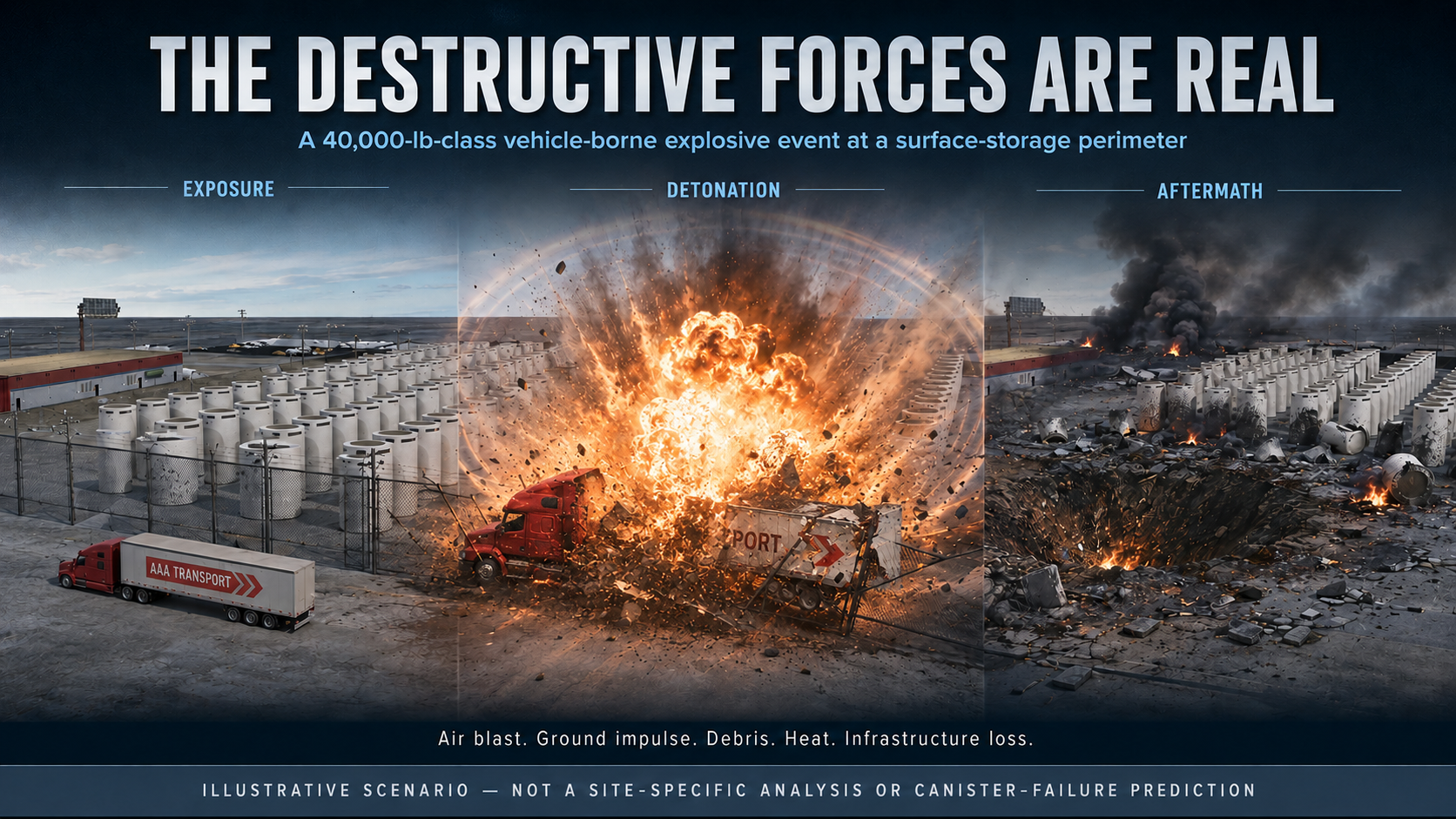
Illustrative three-stage scenario showing surface spent-fuel storage before, during and after a severe vehicle-borne explosive event, with the truck visibly disintegrating at the fence line during detonation
Illustrative scenario: exposure, detonation and aftermath. Select the image to inspect the full-resolution detail.
Essential qualificationNo public website image can establish how a particular facility, storage configuration or cask design would perform. That requires controlled, site-specific engineering analysis using protected security information and validated models.
Oklahoma City · April 19, 1995

Oklahoma has already seen what one truck bomb can do.

At 9:02 a.m., a rented Ryder box truck carrying an estimated 4,800-pound fertilizer-based explosive mixture detonated in front of the Alfred P. Murrah Federal Building. The blast destroyed a major portion of the building, triggered progressive collapse, damaged more than 300 nearby buildings and killed 168 people—including 19 children. Hundreds more were injured.

The Murrah Building was not a nuclear facility, and no radioactive inventory was involved. The lesson is narrower and indisputable: a vehicle-borne explosive assembled from commercially available materials produced catastrophic structural damage and mass casualties in the center of an American city.

A necessary distinction

Historical estimates differ depending on whether they describe the physical mixture or its explosive yield. The approximately 4,800-pound figure is a commonly reported mixture estimate; NIST cites an estimated yield equivalent to approximately 4,000 pounds of TNT. Those numbers are not interchangeable, and neither can be scaled directly to predict damage at a spent-fuel facility.

One event. Multiple pathways.

A severe attack does not create one force. It creates several at once.

The central concern is the combined event: blast, ground motion, debris, heat, fire and loss of supporting infrastructure occurring in the same short interval.

01

Air blast

A sudden pressure wave can load exposed equipment, structures and site systems over a wide area.

02

Ground impulse

Energy can transfer through the surface pad and surrounding ground, adding a separate mechanical load.

03

High-velocity debris

Fragments from a vehicle, perimeter and nearby structures can become secondary projectiles.

04

Heat and fire

Intense localized heat and continuing fires can complicate access, inspection and emergency response.

05

Infrastructure loss

Power, communications, monitoring, roads and response capability can be impaired together.

06

Potential dispersion

If radioactive material were damaged, pulverized and released, fine particles could become airborne.

The consequence does not necessarily stop at the fence

If radioactive material is pulverized and released, airborne particles can be carried great distances by prevailing winds.

Actual transport and deposition would depend on particle size, release conditions, wind, weather, terrain and emergency response. This statement is conditional: the illustration does not establish that a release would occur from any particular licensed storage system.

A distributed national obligation

Seventy-nine sites are not one problem. They are 79 continuing responsibilities.

The risk profile is not identical at every location, and existing NRC-regulated systems include more than a fence. But each site still requires an enduring human and institutional system around material that remains at the surface.

Protect

Security, access control, surveillance and response readiness.

Monitor

Inspection, radiation monitoring, records and performance confirmation.

Maintain

Aging management, site systems, concrete pads and supporting infrastructure.

Prepare

Emergency planning, transportation readiness and eventual disposition.

~180,000 metric tonsPotential U.S. spent-fuel inventory by the end of the operating lives of today’s reactors, according to DOE.
What the federal record says

Interim storage has a strong operating record. It is still not permanent disposal.

What NRC reports

Dry-cask systems are designed to contain radiation, manage heat and prevent fission; they are licensed, monitored and required to resist specified natural and man-made events. NRC reports no dry-storage radiation release affecting the public since the first casks were loaded in 1986 and no known or suspected sabotage attempt against a cask-storage facility.

What NuclearSAFE argues

A good interim record should not be mistaken for a permanent national solution. Continued surface storage preserves recurring security, maintenance, emergency-response and financial obligations—and keeps high-hazard material within the domain of future surface events and human institutions.

Storage manages exposure. Disposal changes it.

The strategic objective is to move the hazard away from the surface.

Continued surface management

Accessible—but continuously exposed to the surface environment.

  • Licensed systems designed for safe interim storage
  • Continuing security, surveillance and institutional control
  • Recurring aging-management and site-maintenance obligations
  • Material remains within reach of surface hazards and human activity
Licensed deep geologic disposal

Multiple engineered and geologic barriers below the surface.

  • Depth and selected geology provide substantial physical separation
  • Waste packages, seals and host rock operate as complementary barriers
  • Surface infrastructure can be removed after authorized closure
  • Requires siting, consent, testing, performance assessment and licensing
The NuclearSAFE response

Do not normalize indefinite surface storage. Demonstrate a deep end-state pathway.

SuperLAT® is NuclearSAFE’s proposed deep horizontal disposal architecture: engineered capsules emplaced through surface-operated systems into selected deep geologic formations, with retrievability and permanent closure designed into the system.

Public source basis

Facts separated from the illustrative scenario.

  1. U.S. Department of Energy — Inside One of the Nation’s Biggest Research Projects on Spent Nuclear Fuel (July 7, 2025): more than 95,000 metric tons at 79 sites in over 30 states; approximately 180,000 metric tons projected by the end of current reactor operating lives.
  2. U.S. Nuclear Regulatory Commission — Backgrounder on Dry Cask Storage of Spent Nuclear Fuel: cask design, licensing, monitoring, operating record and NRC’s safety position.
  3. U.S. Environmental Protection Agency — Particle Transport of Radionuclides Following a Radiological Event: literature review of airborne particle transport and deposition following a radiological release.
  4. Federal Bureau of Investigation — Oklahoma City Bombing: rented Ryder truck, destruction of the Murrah Building, more than 300 nearby buildings damaged and 168 people killed.
  5. National Institute of Standards and Technology — Oklahoma City Bombing 1995: structural damage, progressive-collapse findings and the approximately 4,000-pound TNT-equivalent yield estimate.
  6. National Park Service — Oklahoma City National Memorial: the 168 victims memorialized by the Field of Empty Chairs.
  7. Oklahoma Historical Society — Encyclopedia of Oklahoma History and Culture: Oklahoma City Bombing: the 4,800-pound bomb estimate, Ryder truck, casualties and damage to more than 300 buildings.
Security-conscious presentation: This page deliberately omits standoff distances, blast pressures, site layouts, breach mechanics and other operational details. The event image is conceptual and should not be used as an engineering result.

The national end state should be deeper than a concrete pad.

Start a conversation