
Designed for the regulatory end-state.
NuclearSAFE is engineering CinGOT™, SuperLAT®, SuperSILO® and the supporting technology portfolio around the performance functions that define geologic disposal: preclosure protection, retrievability, qualified waste packages, multiple barriers, site-specific geology, performance confirmation, quality assurance and permanent closure.
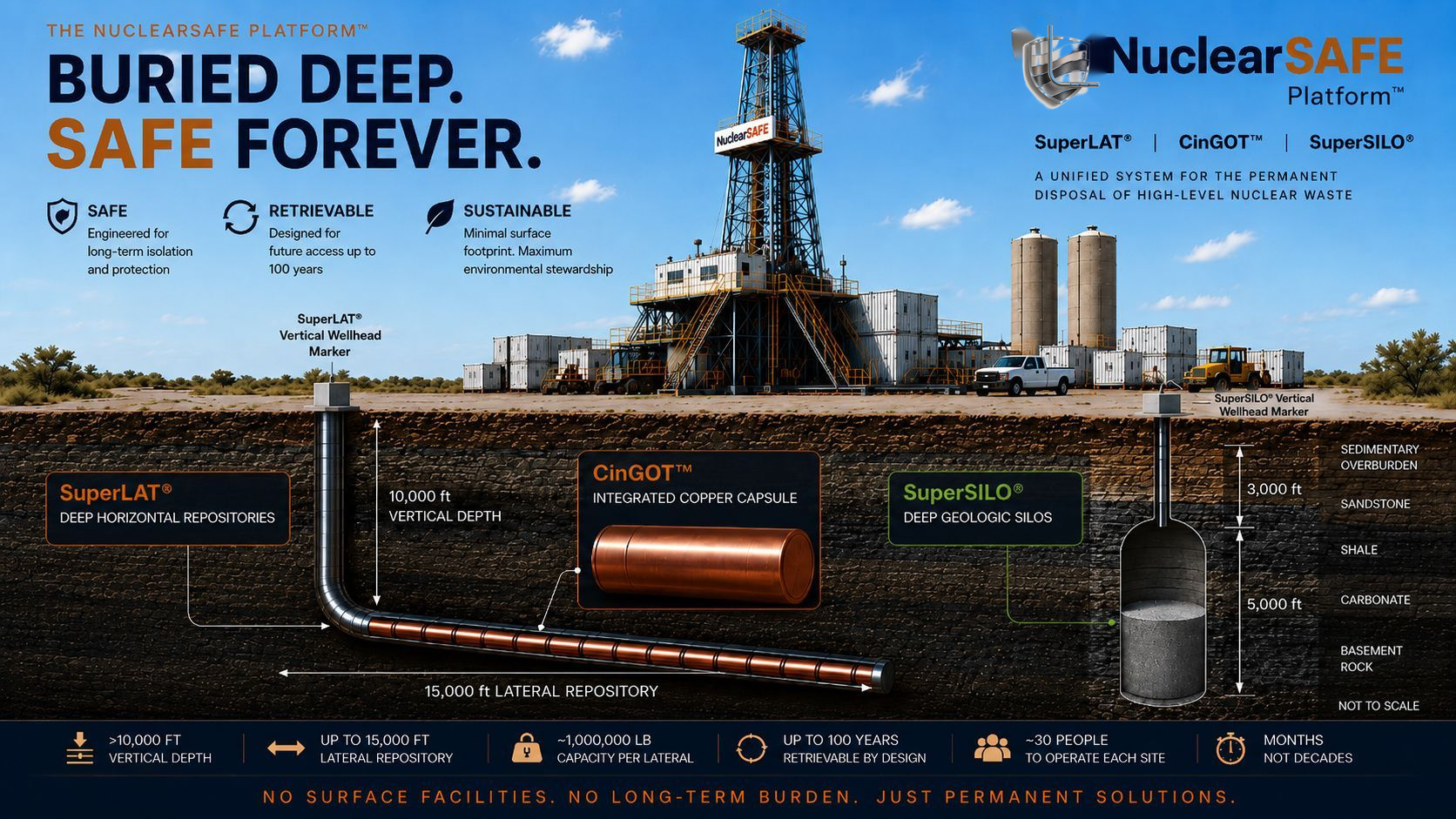
Regulatory fit by design—not regulatory approval by assertion.
The original 2017 NuclearSAFE Part 60 crosswalk correctly focused on worker protection, retrievability, postclosure performance, engineered barriers, geology and controlled-area requirements. The current NuclearSAFE architecture extends that logic to waste-form qualification, performance confirmation, site characterization, quality assurance, monitoring, closure and the licensing evidence needed to demonstrate reasonable assurance.
This page does not claim NRC approval, a licensed NuclearSAFE repository, or completed site-specific compliance. It shows how the technology architecture is being designed to address—and where appropriate target performance margins beyond—selected Part 60 criteria. Demonstration, performance assessment, regulatory review and licensing remain required.
What Part 60 asks for. How NuclearSAFE responds.
The current eCFR version of Part 60 frames disposal as an integrated system of operations, waste packages, engineered barriers, geology, monitoring and closure. NuclearSAFE's advantage is that these functions have been developed as an integrated technology platform rather than as disconnected components.
Preclosure radiation protection
Radiation exposures, radiation levels and releases to unrestricted areas must remain within Part 20 and applicable EPA limits through permanent closure.
Remote, surface-operated handling
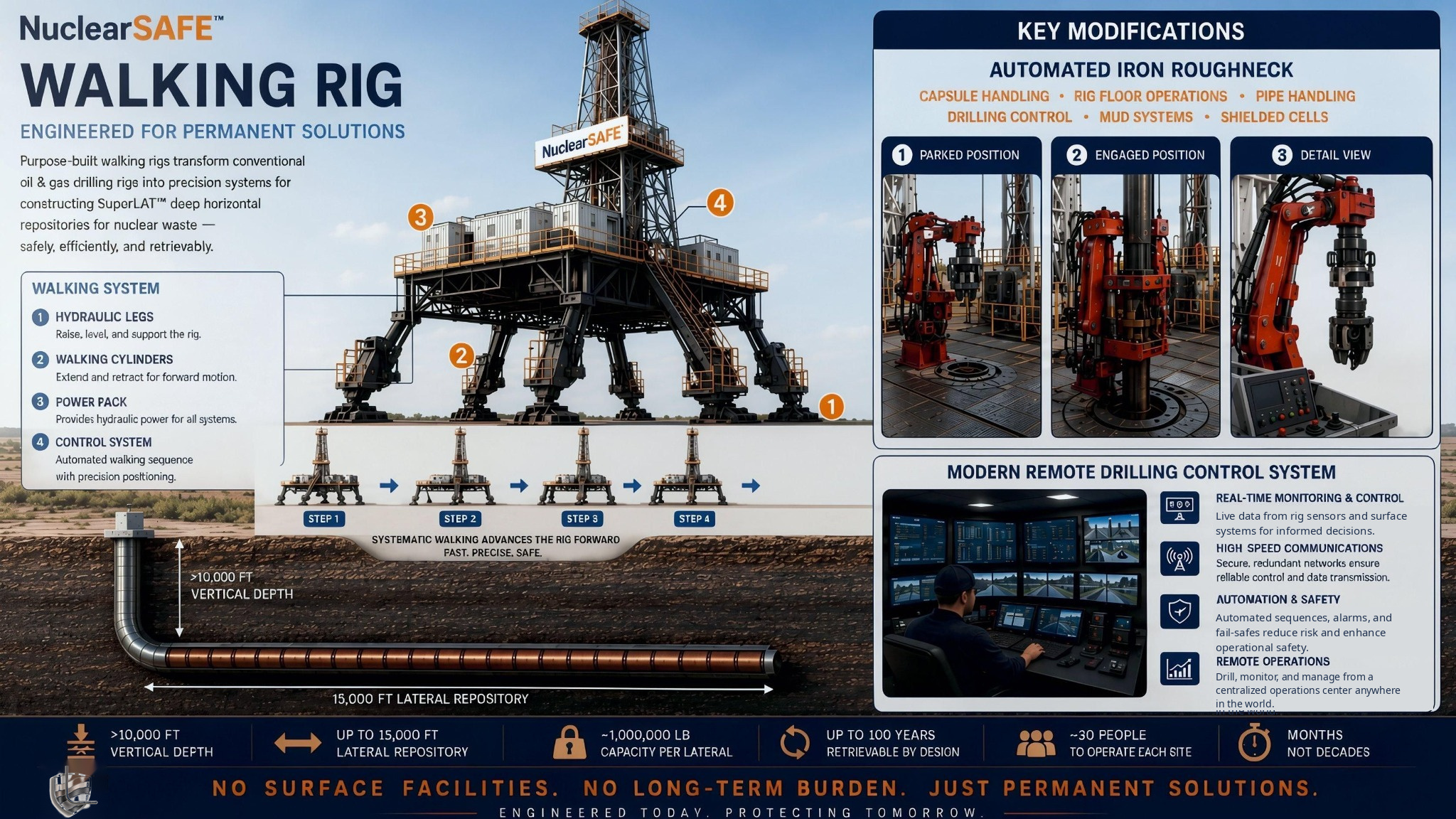
Automated capsule handling, remote drilling control, shielded cells and surface-operated emplacement are intended to reduce routine personnel proximity to radioactive packages and eliminate the need for an underground workforce.
§60.133(c)
Retrievability
The repository must preserve the option to retrieve any or all emplaced waste on a reasonable schedule, beginning at any time up to 50 years after emplacement starts unless NRC specifies another period.
SuperLAT® retrieval architecture
Horizontal access, oilfield-derived re-entry methods, casing access, retrieval tooling and location/ranging methods are incorporated as design functions. NuclearSAFE's longer stewardship objective can target up to 100 years where technically and regulatorily appropriate.
Waste package & waste form
HLW must be in solid form and sealed containers; package design must consider corrosion, thermal effects, mechanical strength, radiation damage, handling, retrieval and identification.
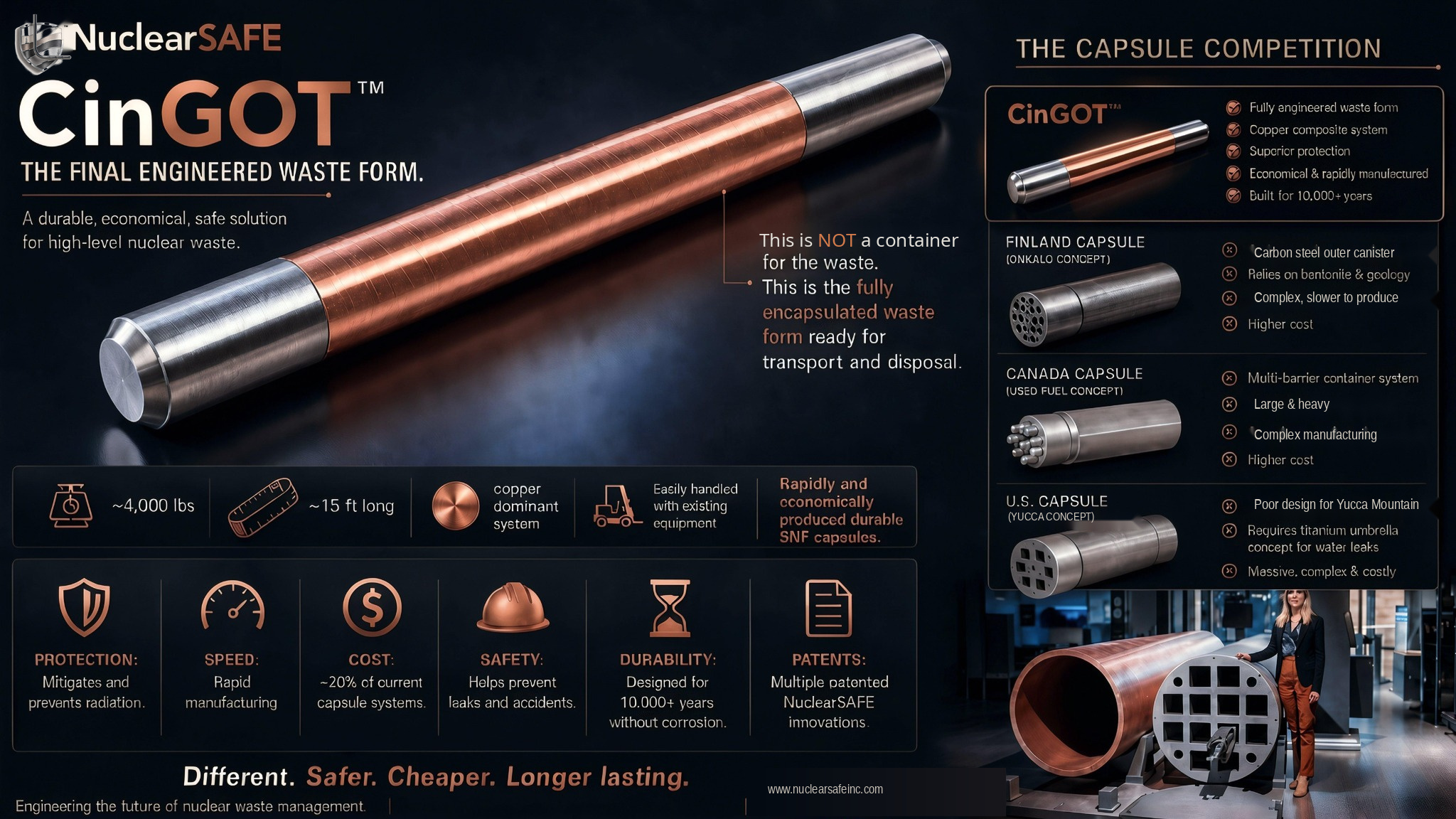
CinGOT™ engineered waste form
CinGOT is intended to convert intact spent-fuel assemblies into a robust, copper-dominant encapsulated waste form engineered for handling, transport, emplacement and retrieval. Materials qualification, criticality, thermal, corrosion and manufacturing evidence would be part of the licensing basis.
§60.113
Postclosure system & barrier performance
The geologic setting, engineered barrier system, wellbores and seals must work together to control releases after closure. Part 60 includes 300–1,000 year waste-package containment, gradual release criteria and a ≥1,000-year groundwater travel-time reference.
Multiple-barrier disposal architecture
NuclearSAFE combines the waste form, steel/cement well construction, engineered seals, deep host geology and closure systems such as RockWELD™. The former “engineered / structural / stratigraphic barrier” concept is retained, but now expressed as a site-specific, performance-assessment-driven multiple-barrier system rather than absolute lifetime claims.
Preclosure controlled area
A controlled area is required. Category 2 design-basis events must meet specified dose limits at or beyond its boundary, which must be at least 100 meters from surface facilities.
Small-footprint operating concept
SuperLAT's surface-centered operating model is intended to minimize permanent surface infrastructure while allowing a controlled operating area to be sized by the actual safety analysis. After closure, the surface can transition toward a minimal marker and monitoring footprint.
§60.140–143
Performance confirmation
Repository behavior must be confirmed through monitoring, laboratory and field testing, in-situ experiments, geotechnical measurements and representative waste-package monitoring until permanent closure.
Digital monitoring + physical testing
NuclearSAFE's sensor concepts, thermocouples, AI-assisted analysis, digital-twin methodology and retrievable architecture can support an evidence loop linking field measurements to design assumptions, while representative CinGOT packages can be monitored and tested over time.
Subpart G
Safety analysis, QA & records
A license application must provide a Safety Analysis Report, design bases, codes and standards, QA for safety-important systems and barriers, and permanent records supporting repository construction and performance.
Nuclear-grade evidence program
NuclearSAFE's next regulatory-development layer is not another patent. It is controlled engineering evidence: design control, configuration management, materials traceability, verified software/models, supplier qualification, nonconformance control, records and independent review.
Meeting the rule is the floor. Engineering margin is the objective.
Some NuclearSAFE design choices can create potential performance margin beyond selected regulatory reference points. These are design targets—not claims of demonstrated regulatory compliance.
Part 60 uses a 50-year retrievability design point unless another period is approved. SuperLAT is being developed around a longer stewardship option, potentially up to 100 years.
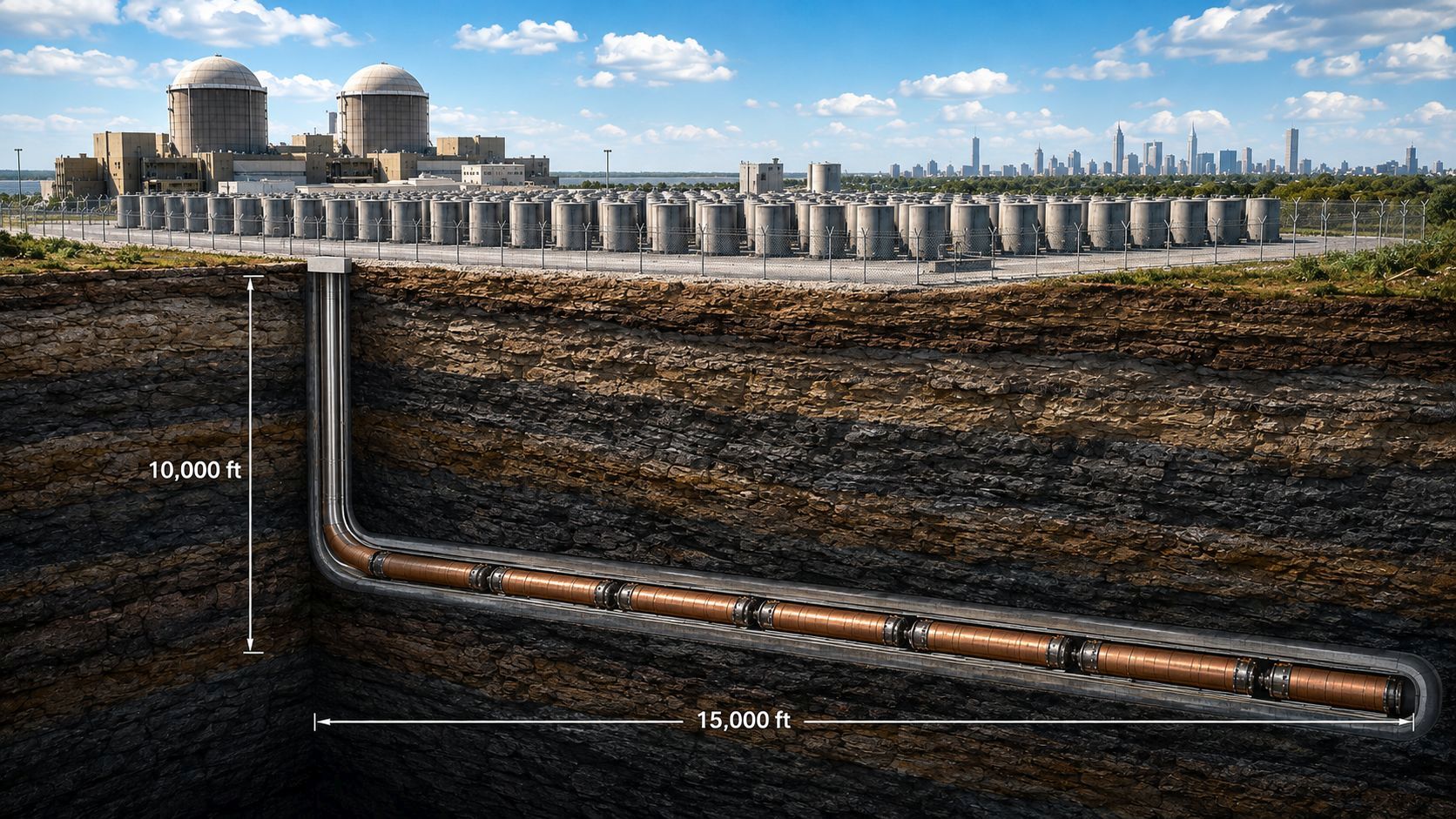
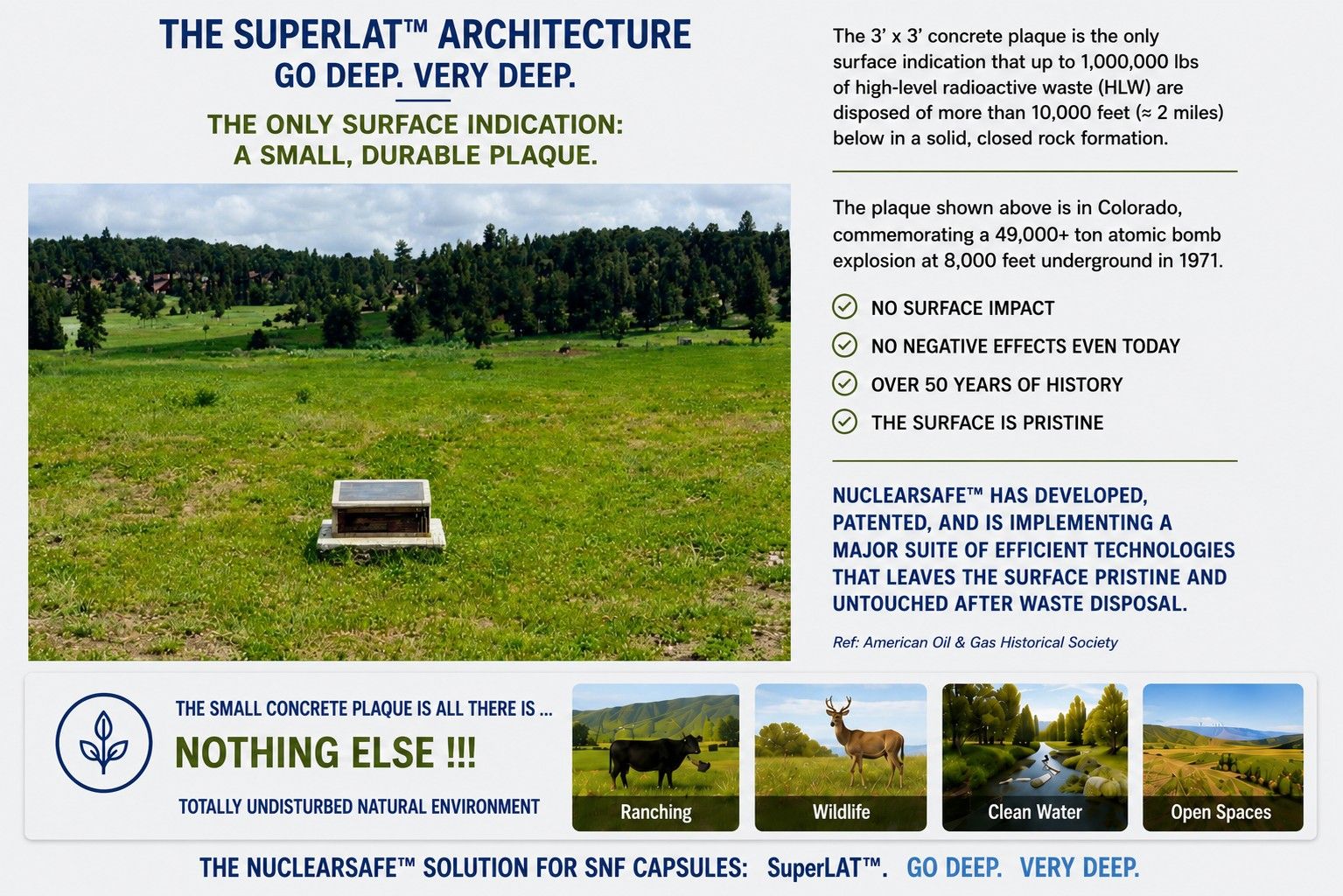
Benefit: greater optionality before final closure.Part 60 does not prescribe a single mandatory repository depth. SuperLAT targets deep host formations—typically more than 10,000 feet—so geology, hydrology and human-intrusion pathways can be evaluated with substantial vertical separation.
Benefit: depth becomes a performance feature, not a substitute for analysis.Part 60 requires safe operations; it does not require underground personnel. NuclearSAFE's objective is surface-operated, automated emplacement and retrieval using adapted industrial systems.
Benefit: lower occupational exposure potential and fewer underground operational hazards.CinGOT, well casing/cement, engineered plugs/seals, host geology and final closure are intended to function as complementary barriers rather than depending on a single package or a single geological feature.
Benefit: diversity and redundancy can strengthen the reasonable-assurance case.The requirement is systemic. So is the NuclearSAFE response.
The regulatory development roadmap.
NuclearSAFE's next stage is to convert patented technology into controlled, testable and independently reviewable evidence.
Define design bases
Translate platform functions into safety functions, design criteria, operating envelopes and failure scenarios.
Characterize candidate geology
Geology, hydrology, geochemistry, tectonics, thermal response and groundwater pathways.
Demonstrate hardware
Full-scale non-radioactive CinGOT, handling, emplacement, retrieval, sealing and monitoring demonstrations.
Build performance assessment
Coupled thermal, hydrologic, mechanical, chemical, criticality and radionuclide-transport analyses.
Implement nuclear QA
Controlled data, verified models, design control, records, supplier qualification and independent review.
Enter the DOE/NRC pathway
Demonstration sponsorship, statutory/site pathway, licensing framework, Safety Analysis Report and regulatory review.
Part 60 is a generic DOE repository regulation. It is not a shortcut around federal law.
10 CFR Part 60 governs NRC licensing of DOE geologic repositories under the Nuclear Waste Policy Act, except Yucca Mountain, which is governed by 10 CFR Part 63. A future SuperLAT deployment for commercial SNF/HLW would therefore require an authorized federal/site pathway, DOE participation or sponsorship, the applicable NRC licensing framework, EPA standards, site characterization, environmental review, performance assessment, construction authorization and a license to receive and possess waste.
- Technology fit: NuclearSAFE can engineer to the performance functions now.
- Regulatory proof: compliance must ultimately be demonstrated with site-specific data, tested hardware and controlled analysis.
- Licensing status: NuclearSAFE technologies are not currently NRC-approved disposal systems.
Part 60 does not stand alone.
A deployable U.S. program would also interact with radiation protection, environmental review, transportation, storage, security and EPA disposal standards.
Grounded in the regulation. Updated for the current platform.
- Electronic Code of Federal Regulations — 10 CFR Part 60 (current eCFR consulted August 2026).
- U.S. Nuclear Regulatory Commission — High-Level Waste Disposal: How We Regulate.
- U.S. EPA — Environmental Radiation Protection Standards for SNF/HLW.
- NuclearSAFE 2017 Part 60 performance-objective crosswalk — historical starting document used to develop this updated page.