Each opportunity below can be separated into a modest first study or demonstration rather than requiring DOE to adopt an entire disposal architecture at once.
01 · SNF / HLW
Spent nuclear fuel: storage → disposal
Storage manages the inventory. Disposal resolves it.
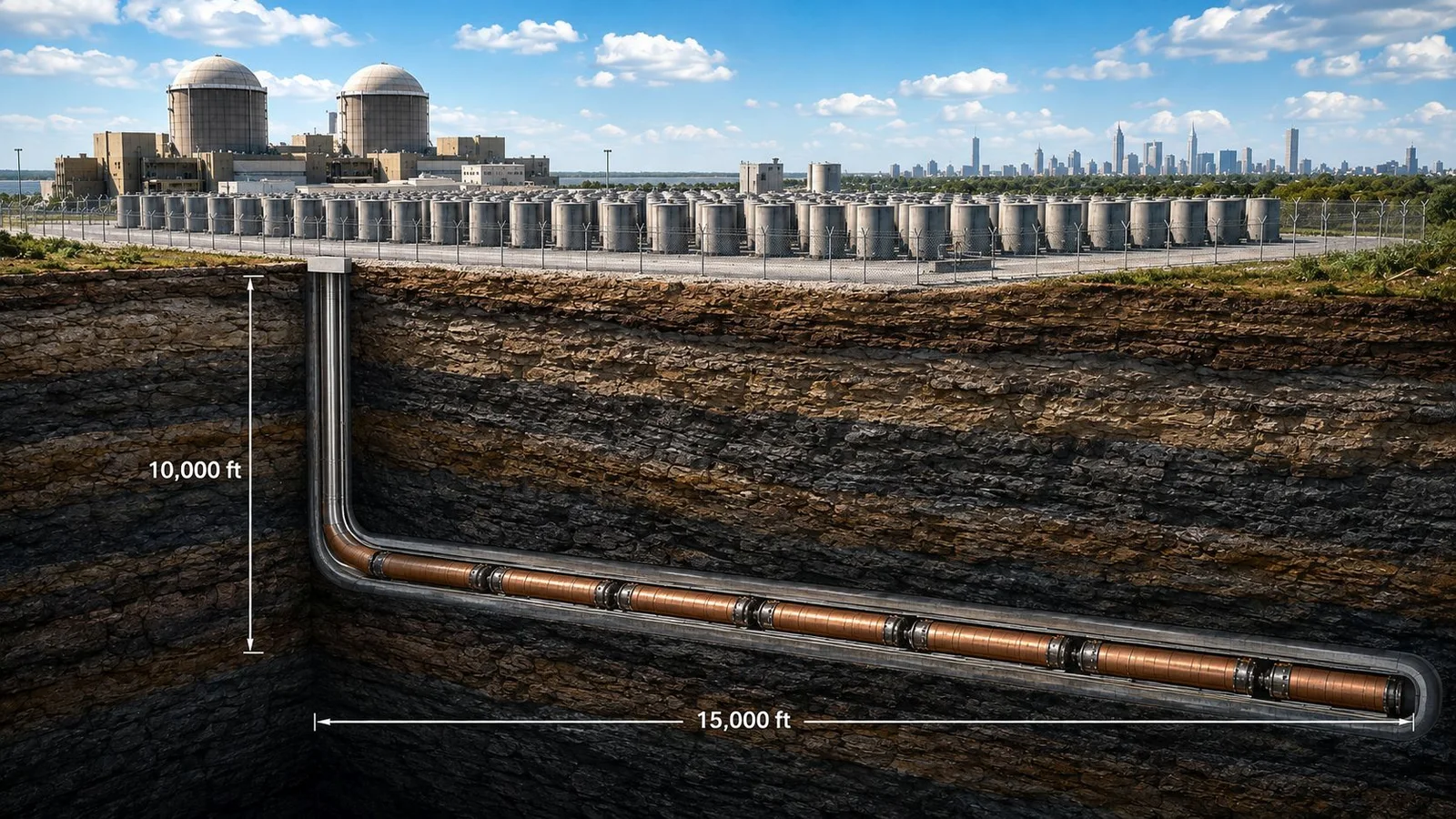
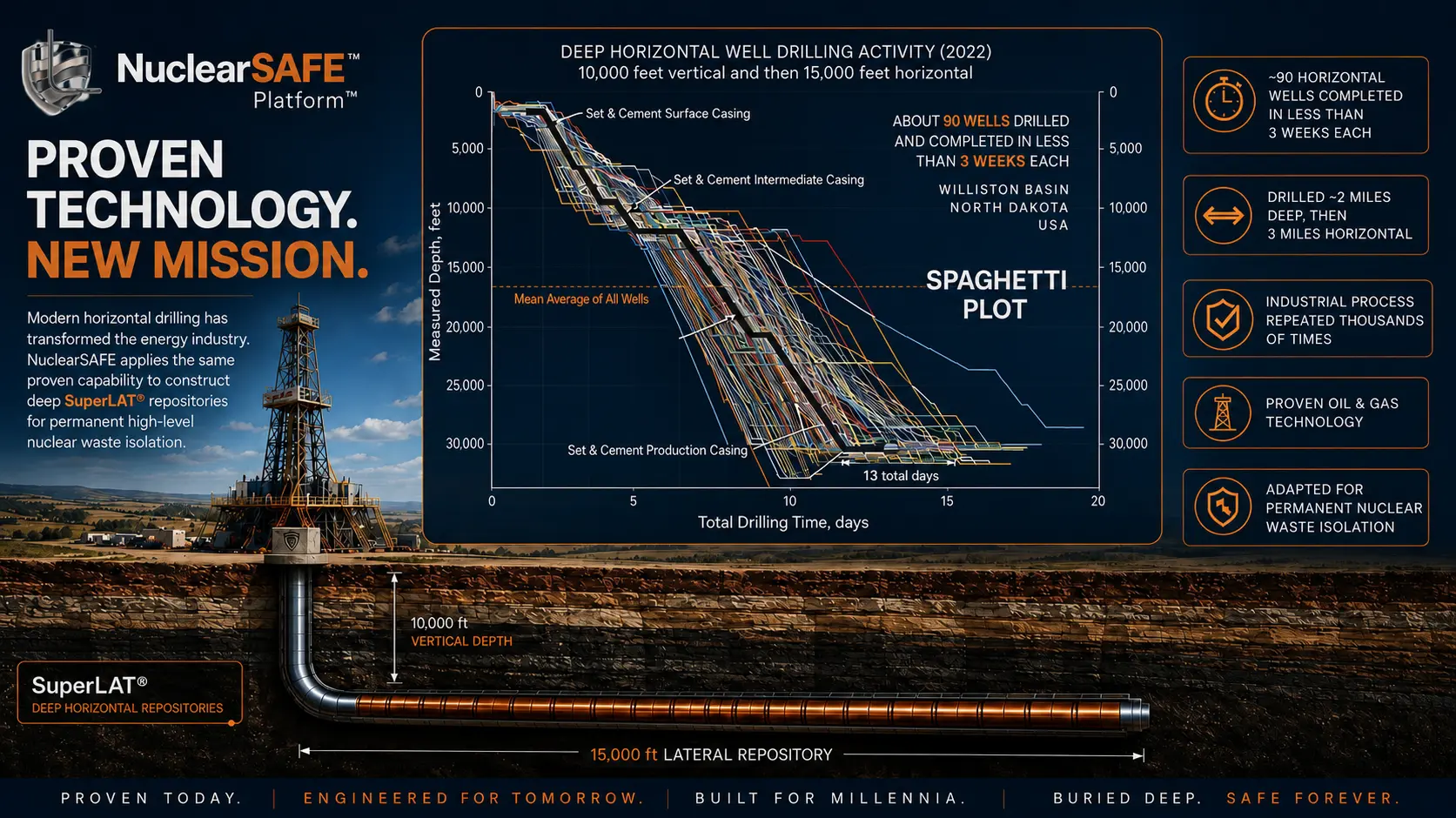
CinGOT™ and SuperLAT® are intended to create a disposal-ready engineered waste form and a deep, retrievable geologic emplacement architecture.
First DOE step: full-scale non-radioactive CinGOT/SuperLAT emplacement-and-retrieval demonstration with independent witnessing.
02 · HANFORD SPECIALTY WASTE
Cesium / strontium capsules
Interim dry storage is not final disposition.
DOE is moving 1,936 highly radioactive capsules into long-term interim dry storage while the final disposition pathway remains to be determined.
First DOE step: terminal-disposition engineering study for specialized high-activity capsules using NuclearSAFE encapsulation and deep-geologic options.
03 · HANFORD TANK WASTE
Selected liquid and secondary streams
Treat what must be treated. Avoid unnecessary process where another compliant end state may exist.
SES and SuperSILO® offer a platform for evaluating selected stabilized liquid, slurry or secondary waste streams—subject to classification, chemistry, performance and regulatory requirements.
First DOE step: waste-stream screening + bench chemistry + geologic-disposition feasibility study.
04 · PERMANENT DISPOSAL
Beyond one mined-repository architecture
A geologic repository does not have to begin as a mine.
SuperLAT offers a modular deep-horizontal architecture that can be evaluated within the applicable federal statutory and regulatory framework. Historic repository work reinforces the importance of site-specific hydrology and geology.
First DOE step: DOE-sponsored surrogate wellbore demonstration + generic performance-assessment comparison.
05 · LLW
Repurpose disturbed land intelligently
Existing mined land can become engineered infrastructure.
NuclearSAFE's OPM concept evaluates suitable large open-pit or disturbed mine sites for engineered LLW disposal using geology, barriers, drainage, monitoring and closure—not simple dumping.
First DOE step: national screening study of candidate disturbed sites against LLW siting and performance requirements.
06 · URANIUM / DUF6
Conversion addresses chemistry. Disposition addresses inventory.
DOE is successfully converting DUF6; NuclearSAFE focuses on long-term end-state options.
Patented NuclearSAFE concepts can be evaluated for selected depleted-uranium oxide, uranium-bearing residuals and other difficult uranium materials with limited reuse value.
First DOE step: disposition pathway comparison after conversion, including cost, transport, geology and lifecycle stewardship.
07 · IN-SITU TREATMENT
Selected waste: treat it where it is
Less excavation. Less handling. Fewer interfaces.
NuclearSAFE's in-situ vitrification and shallow geologic concepts can be screened for waste types where immobilization in place could reduce handling and transportation.
First DOE step: controlled surrogate materials test + applicability matrix for candidate DOE waste streams.
08 · CROSS-AGENCY MATERIALS
Depleted-uranium munitions and specialized radioactive materials
Some inventories need purpose-built end states.
Deep engineered disposition may provide options for selected DU-bearing military materials and other difficult government-owned radioactive products.
First federal step: DOE/DoD technical scoping study defining ownership, classification, transport and disposal requirements.
09 · SITING / GOVERNANCE
Compact footprint + consent + federal authorization
Smaller facilities can widen the conversation.
Modular deep systems may create more siting choices for willing communities and sovereign Tribal Nations. NuclearSAFE views this as a governance opportunity—not a regulatory shortcut.
First DOE step: integrate compact deep-disposal concepts into consent-based siting and community-benefit scenario studies.